
What 10,000 Hours of Meditation Taught Me About Chronic Pain
 By Shane Dowd , CES, CMP
I have been meditating two to three hours a day for over a decade.
Dozens of long retreats. Sits of twenty, thirty, forty-five, sixty days. Ten to eleven hours of practice daily, in silence, doing nothing but observing my own mind and body with as much precision and honesty as I could bring to it.
I did not start this practice to address my chronic pain. I started it because I was drawn to understanding the nature of the mind.
But what those ten thousand hours taught me about pain turned out to be the most practically useful thing I have ever learned. More useful than any diagnosis I received. More useful than any treatment I pursued. More useful, in some ways, than everything I had learned over a decade of helping myself and thousands of others navigate physical pain and injury.
Here is what I learned.
The pain I thought was a seven or eight out of ten was often a two or three. The rest was my nervous system.
The Alarm That Never Turns Off
Most people in chronic pain are living with a nervous system that is stuck in permanent high alert.
Think of it like a smoke alarm with a broken sensor. The alarm is real. The wiring is real. The sound is absolutely real. But the threat it is responding to has been grossly distorted. The alarm is going off not because the house is on fire, but because someone made toast.
This is not weakness. It is not imagination. It is biology.
When the nervous system experiences significant pain, whether from injury, surgery, or prolonged stress, it adapts. It becomes more vigilant. It lowers the threshold at which it decides to sound the alarm. It starts scanning constantly for signals that resemble the original threat. And over time, if nothing intervenes to recalibrate it, this heightened state of alert becomes the new baseline.
The pain signals keep firing not because the tissue is still damaged, but because the nervous system has learned that firing is the safe strategy. It would rather cry wolf a thousand times than miss a real threat once.
The result is a person who experiences real, genuine, undeniable pain that is nonetheless far larger than the underlying physical problem alone can explain.
I know this because I felt it dissolve under my own skin, sitting in silence, thousands of times.
What the Retreats Revealed
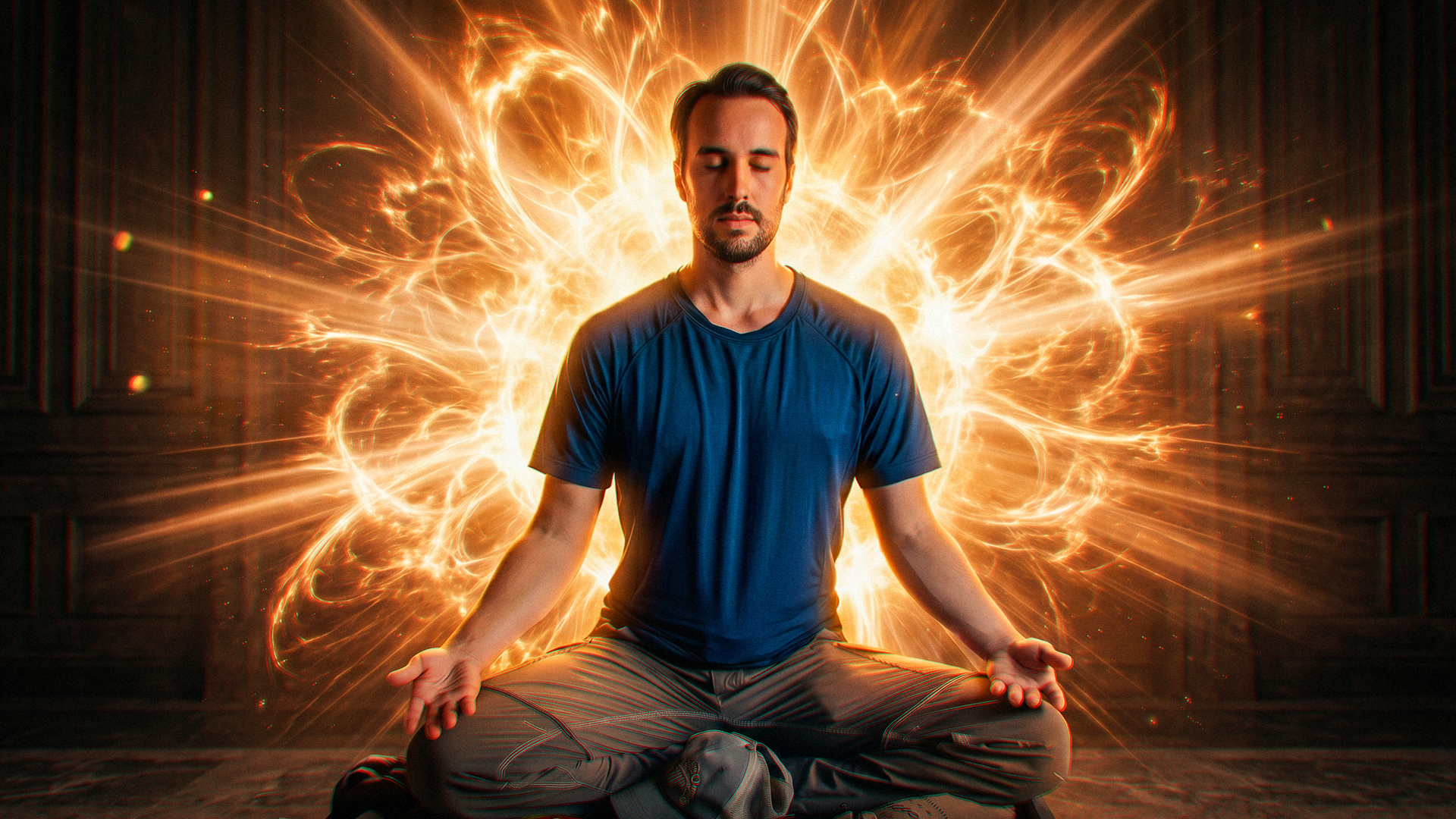
The first time I noticed it was on one of my early retreats.
Around day fifteen of a longer sit, the practice shifts from breath meditation to Vipassana. You stop focusing on the breath and start scanning the body systematically, observing every sensation that arises without trying to hold onto the pleasant ones or push away the unpleasant ones.
Simply watching them as what they are: impersonal, changing, temporary phenomena. What emerges naturally from that practice, not as a concept but as a lived experience, is a quality of equanimity. A balanced, non-reactive mind that can be present with sensation without being consumed by it.
In that state, I noticed something about my pain that I could not un-notice. It was smaller than I thought. The deep, familiar ache in my hip, the kind I had carried for years, the kind I had learned to factor into every training session, every morning, every long car ride, had changed character.
What had been a spreading, consuming presence had contracted into something almost modest. A sensation among other sensations, rather than the loudest thing in the room. Nothing had happened to my hip. No treatment, no adjustment, no medication.
The only thing that had changed was the noise surrounding the signal.
Because here is what serious meditation practice reveals, slowly and then all at once: most of us are carrying a constant low-grade agitation in our nervous systems that we have stopped noticing because it has been there so long. Background static. Unprocessed tension. A baseline level of threat response that hums beneath everything we do and feel.
We mistake it for normal because it is familiar. But it is not neutral. It is amplifying every pain signal that passes through it, the way a volume knob turned to seven makes even quiet sounds feel overwhelming.
When you sit in stillness for ten or eleven hours a day, practicing nothing but precise, non-reactive observation of whatever arises in body and mind, that static gradually settles. Not instantly. The way sediment settles in a glass of water when you finally stop shaking it.
Over days, the baseline agitation drops toward something closer to the nervous system's natural resting state. And when that happens, the pain changes.
What I had been living with as a seven or eight became, in that settled state, a two or three.
The gap between those numbers is not a minor adjustment. It is the difference between a life organized around pain and a life in which pain is simply one manageable feature of an otherwise full existence.
This insight did not arrive once and stay fixed. It deepened. On longer retreats, thirty, forty-five, sixty days, the same realization settled into layers I had not previously accessed.
What began as a glimpse on an early ten-day course became, over thousands of hours of practice, a lived understanding I could no longer separate from everything I know about pain, recovery, and the relationship between mind and body.
I could no longer believe that pain was a purely physical phenomenon. I had felt with my own body, not read in a textbook or heard from a colleague, how profoundly the brain and nervous system shape the experience of pain independent of what is happening in the tissue.
This was not a philosophical insight. It was a felt reality that changed how I understood everything.
You Do Not Need a Sixty-Day Retreat
I want to be careful here, because what I just described could easily be read as an argument for extended meditation retreats as the solution to chronic pain. That is not what I am saying.
What the retreats gave me was a dramatic, accelerated, impossible-to-ignore demonstration of something that is also available in much smaller doses through much more accessible practices.
The underlying principle is this: a nervous system stuck in chronic high alert will amplify pain beyond what the physical injury alone produces.
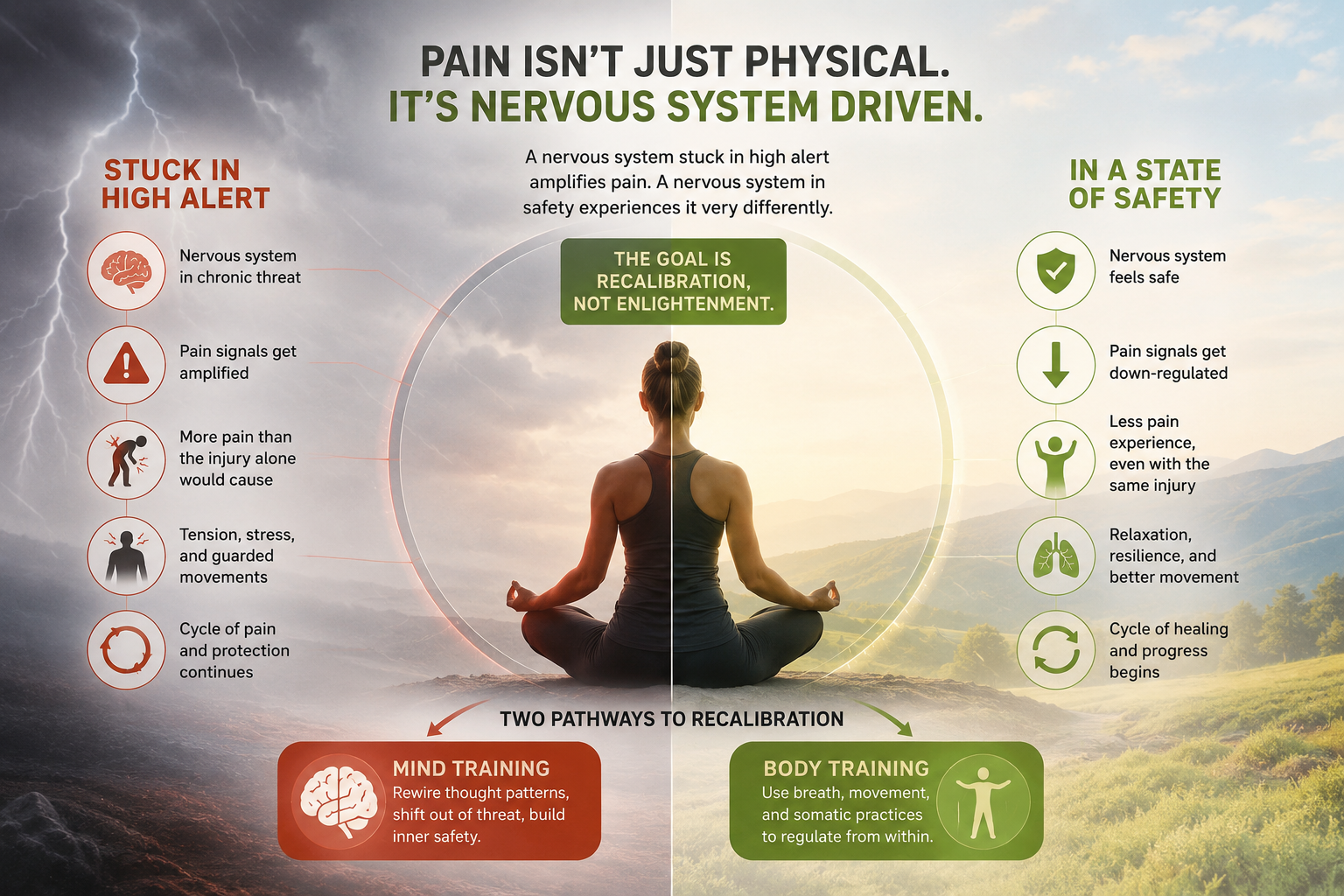
A nervous system that learns to down-regulate, to spend more time in genuine safety rather than perceived threat, will experience that same pain very differently. The goal is not enlightenment. The goal is recalibration.
There are two pathways I have found most effective for getting there.
Meditation and body awareness practice
Vipassana-style meditation, where you systematically scan the body and learn to observe sensations without reacting to them, trains something the nervous system in chronic pain desperately needs: the ability to be present with discomfort without treating it as an emergency.
Most chronic pain is amplified not just by the sensation itself but by the fear, resistance, and mental bracing that surrounds it. Learning to observe sensation with steady, non-reactive attention gradually loosens that grip.
The alarm does not disappear immediately. But it begins, slowly, to recalibrate. Twenty minutes of consistent daily practice moves the needle in ways that accumulate significantly over weeks and months.
The retreats accelerated things dramatically for me. But the direction of change is available to anyone willing to show up for it daily.
Graded exposure through guided movement
The nervous system learns safety exactly the way it learned danger: through repeated lived experience.
Every time you move through a range of motion your nervous system has flagged as threatening, and you come through it without harm, you deposit a small piece of evidence into a growing account.
The alarm recalibrates slightly downward. Do this consistently, progressively, and intelligently, and positions and movements that once triggered a full pain response become, over time, genuinely unremarkable.
The key word is guided. This process done randomly or too aggressively can backfire, loading the nervous system with experiences that confirm threat rather than contradict it. Done with a clinician who understands both the physical mechanics and the neurological process underneath them, it is one of the most reliable pathways out of chronic pain I have encountered in over a decade of helping people recover.
The Dial, Not the Switch
I used to wish there was a moment where everything just switched off. Where the alarm stopped, the pain lifted, and I could get back to living.
That moment never came. What came instead was something quieter and more durable. The most important thing to understand about nervous system retraining is that it does not happen all at once.
It is a dial, not a switch. And the dial moves in response to accumulated evidence, deposited daily, that the world is safer than the nervous system currently believes.
This requires a quality of patience that our healthcare system is not designed to support and our culture does not particularly celebrate. But the direction of change is real. I have felt it across ten thousand hours of my own practice. I have watched it happen in person after person who committed to the process with the right understanding of what they were doing and why.
Chronic pain is not a life sentence. It is a learned state.
A nervous system that has learned to amplify danger can learn, given the right inputs and the right guidance, to settle back toward something closer to the truth.
The house is not on fire. The alarm just needs recalibrating.
Where to Go From Here
At GotROM, our programs are built on everything in this article: graduated movement, nervous system retraining, and the kind of intelligent progressive guidance that gives your body and brain the evidence they need to start turning the alarm back down.
We address pain and injury from head to toe: foot, knee, hip, low back, spine, shoulder, neck, and beyond.
What makes our approach different is who is guiding it.
Our Doctors of Physical Therapy are also strength and conditioning coaches and mobility specialists. They have lived through serious injuries of their own. And they understand, from clinical training and personal experience, that getting you out of pain requires addressing both your nervous system and the physical factors contributing to your pain.
If your nervous system has become an overactive alarm, you don't need to fight against it. You need to start giving your body better inputs, consistently, so it can begin to recalibrate.
You can start with one of our DIY programs and work through the process at your own pace. And if you want more personalized support, you can add 1:1 coaching to your program, giving you direct guidance from a specialist who can review what you're doing, help you make adjustments, and keep you progressing without constantly second-guessing yourself.
You don't need a 60-day meditation retreat to start changing the way your body responds to pain. You just need to start giving it the right inputs and give your body enough time to respond.
Start with a GotROM program and take the first step toward retraining your body.
About The Author

Shane Dowd, CES, CMP is the owner/founder of GotROM.com. He is also a sports performance & mobility coach specializing in injury prevention and flexibility for athletes.

Free download for this topic
How To 10X Your Flexibility
An Insider's Guide to Accelerated Gains
GET THE FREE EBOOK


